Coloradoan.com - Full Article
Jacy Marmaduke, jmarmaduke@coloradoan.com
October 29, 2015
A hefty chunk of annual funding for Colorado trails hangs in the balance because of the jeopardized Land and Water Conservation Fund, which recently expired and faces obstacles for renewal in Congress.
A bill to recharge the 50-year-old source of federal money for national and municipal conservation efforts – think parks, trails and playgrounds – is frozen in the U.S. House of Representatives natural resources committee. The committee’s chairman, Rep. Rob Bishop, R-Utah, has blocked hearings on the bill because he wants to revamp it.
Colorado received about $770,000 in stateside funding from LWCF in 2014; $43.4 million went to the entire country and territories.
The Colorado Department of Parks and Wildlife divvies the state allocation among local and regional trail projects. The fund made up about 37 percent of its allocations for trail projects statewide this year...
Read more here:
http://www.coloradoan.com/story/news/2015/10/29/colo-trail-funding-risk-federal-fund-expires/74770072/
Friday, October 30, 2015

Forest Service SE Region seeks applicants for recreation advisory committee
FS.USDA.gov
Release Date: Oct 14, 2015
Contact(s): Nancy Snoberger, 936-639-8548
The U.S. Forest Service is seeking nominations to fill 11 positions on a new Southern Region Recreation Resource Advisory Committee for national forests across the Southeast.
The committee will take on the important task of recommending whether forests in 13 southern states and Puerto Rico adopt new recreation fees or change existing ones. Potential nominees must represent the following forest-related interests:
-- Recreational uses including: camping, motorized recreation, non-motorized recreation, wildlife and nature viewing/visiting interpretive sites, hunting and fishing;
-- Environmental groups;
-- Outfitters and guides;
-- State tourism interests;
-- American Indian tribes; and
-- Local government interests
Members will be appointed for two or three-year terms based on the following criteria:
-- Which interest groups they represent and how well they are qualified to represent that group.
-- Why they want to serve on the committee and what they can contribute.
-- Their past experience in working successfully as part of a collaborative group.
Nominees’ demonstrated ability to represent minorities, women and persons with disabilities will be considered in membership selections. U.S. Department of Agriculture policies regarding equal opportunity will be followed. Committee members will receive travel and per diem expenses for regularly scheduled meetings; however, they will not receive compensation.
The committee’s jurisdiction will cover the national forests in Alabama, Arkansas, Florida, Georgia, Kentucky, Louisiana, Mississippi, North Carolina, Oklahoma, South Carolina, Tennessee, Texas, Virginia and Puerto Rico.
More information is available at http://www.fs.usda.gov/main/r8/recreation/racs or by contacting Caroline Mitchell at 501-321-5318 or r8_rrac@fs.fed.us. Completed nomination forms are due by Dec. 31, 2015 to: Recreation RAC Nomination, P.O. Box 1270, Hot Springs, Arkansas, 79102.
Release Date: Oct 14, 2015
Contact(s): Nancy Snoberger, 936-639-8548
The U.S. Forest Service is seeking nominations to fill 11 positions on a new Southern Region Recreation Resource Advisory Committee for national forests across the Southeast.
The committee will take on the important task of recommending whether forests in 13 southern states and Puerto Rico adopt new recreation fees or change existing ones. Potential nominees must represent the following forest-related interests:
-- Recreational uses including: camping, motorized recreation, non-motorized recreation, wildlife and nature viewing/visiting interpretive sites, hunting and fishing;
-- Environmental groups;
-- Outfitters and guides;
-- State tourism interests;
-- American Indian tribes; and
-- Local government interests
Members will be appointed for two or three-year terms based on the following criteria:
-- Which interest groups they represent and how well they are qualified to represent that group.
-- Why they want to serve on the committee and what they can contribute.
-- Their past experience in working successfully as part of a collaborative group.
Nominees’ demonstrated ability to represent minorities, women and persons with disabilities will be considered in membership selections. U.S. Department of Agriculture policies regarding equal opportunity will be followed. Committee members will receive travel and per diem expenses for regularly scheduled meetings; however, they will not receive compensation.
The committee’s jurisdiction will cover the national forests in Alabama, Arkansas, Florida, Georgia, Kentucky, Louisiana, Mississippi, North Carolina, Oklahoma, South Carolina, Tennessee, Texas, Virginia and Puerto Rico.
More information is available at http://www.fs.usda.gov/main/r8/recreation/racs or by contacting Caroline Mitchell at 501-321-5318 or r8_rrac@fs.fed.us. Completed nomination forms are due by Dec. 31, 2015 to: Recreation RAC Nomination, P.O. Box 1270, Hot Springs, Arkansas, 79102.
Tragedy of John Wayne (Trail)
Inlander.com - Full Article
Why the John Wayne Pioneer Trail is worth saving
October 29 2015
By Scott A. Leadingham
John Wayne isn't just a movie star. He's a pioneer. In Washington state, he lends his name to an incredible amenity that makes the Evergreen State envied in the rest of the country. The John Wayne Pioneer Trail is, as far as anyone can tell, the nation's longest rail trail.
Now two state representatives — Joe Schmick, R-Colfax, and Mary Dye, R-Pomeroy — prompted by concerns of adjacent landowners, want to ditch the trail through Eastern Washington.
Not to be hyperbolic, but that would be a tragedy.
Spokane and North Idaho residents will recognize the former rail line, called the Milwaukee Road, as the Route of the Hiawatha, the popular bike path that straddles the Montana-Idaho border. If you drive from Spokane to Seattle along I-90, you'll begin seeing signs for John Wayne Trail Access and Iron Horse State Park west of Ellensburg.
While the western section from Ellensburg to North Bend is well maintained, with good access points and restrooms, the eastern portion from the Columbia River to the Idaho border is largely unimproved, with numerous missing trestles. It's used mostly by horse riders and hearty mountain bikers. Many areas are unmarked and largely forgotten by the Washington State Parks and Department of Natural Resources, which jointly oversee the John Wayne Trail...
Read more here:
http://www.inlander.com/spokane/tragedy-of-john-wayne/Content?oid=2597582
Why the John Wayne Pioneer Trail is worth saving
October 29 2015
By Scott A. Leadingham
John Wayne isn't just a movie star. He's a pioneer. In Washington state, he lends his name to an incredible amenity that makes the Evergreen State envied in the rest of the country. The John Wayne Pioneer Trail is, as far as anyone can tell, the nation's longest rail trail.
Now two state representatives — Joe Schmick, R-Colfax, and Mary Dye, R-Pomeroy — prompted by concerns of adjacent landowners, want to ditch the trail through Eastern Washington.
Not to be hyperbolic, but that would be a tragedy.
Spokane and North Idaho residents will recognize the former rail line, called the Milwaukee Road, as the Route of the Hiawatha, the popular bike path that straddles the Montana-Idaho border. If you drive from Spokane to Seattle along I-90, you'll begin seeing signs for John Wayne Trail Access and Iron Horse State Park west of Ellensburg.
While the western section from Ellensburg to North Bend is well maintained, with good access points and restrooms, the eastern portion from the Columbia River to the Idaho border is largely unimproved, with numerous missing trestles. It's used mostly by horse riders and hearty mountain bikers. Many areas are unmarked and largely forgotten by the Washington State Parks and Department of Natural Resources, which jointly oversee the John Wayne Trail...
Read more here:
http://www.inlander.com/spokane/tragedy-of-john-wayne/Content?oid=2597582
Thursday, October 29, 2015
Recreational Trails Program Included In House Highway Bill
Horsecouncil.org
Submitted by admin on Thu, 10/22/2015
On October 22, 2015, the House Transportation and Infrastructure Committee approved its version of a multi-year national highway bill known as the STRR Act. (HR 3763). The bill would reauthorize the Federal Highway Administration’s Recreational Trails Program (RTP).
Since its inception RTP has provided money for thousands of state and local trail projects across the country, including many that benefit equestrians. RTP provides funding directly to the states for recreational trails and trail-related facilities for all recreational trail users. It is funded with a portion of the gas taxes paid into the Highway Trust Fund by recreational off-highway vehicle users.
Earlier this year, the Senate passed its version of a multi-year national highway bill, called the DRIVE Act. The Senate bill would also reauthorize Recreational Trails Program.
It is a victory for recreational users that RTP has been included in both the House and Senate versions of the bill.
The full House must now take action on the bill.
If you have any questions, please contact the AHC at http://www.horsecouncil.org/.
Submitted by admin on Thu, 10/22/2015
On October 22, 2015, the House Transportation and Infrastructure Committee approved its version of a multi-year national highway bill known as the STRR Act. (HR 3763). The bill would reauthorize the Federal Highway Administration’s Recreational Trails Program (RTP).
Since its inception RTP has provided money for thousands of state and local trail projects across the country, including many that benefit equestrians. RTP provides funding directly to the states for recreational trails and trail-related facilities for all recreational trail users. It is funded with a portion of the gas taxes paid into the Highway Trust Fund by recreational off-highway vehicle users.
Earlier this year, the Senate passed its version of a multi-year national highway bill, called the DRIVE Act. The Senate bill would also reauthorize Recreational Trails Program.
It is a victory for recreational users that RTP has been included in both the House and Senate versions of the bill.
The full House must now take action on the bill.
If you have any questions, please contact the AHC at http://www.horsecouncil.org/.
Kentucky Back Country Horsemen Appointed to Statewide Boards
October 27 2015
Press Release - Kentucky Back Country Horsemen (KyBCH) recently announced the appointment by Governor Steve Beshear of two Kentucky Back Country Horsemen to boards supporting trails in Kentucky.
Tracy Mitchell, Vice-Chair of KyBCH and member of the Mammoth Cave Back Country Horsemen, has been appointed to serve on the Kentucky Recreational Trails Authority (KRTA). This authority was created from the demand of Kentuckians and visitors alike for a place to ride, hike and recreate in the Bluegrass State. Also representing equestrian users on KRTA is Roy Cornett from Scott County, a member of the Central Kentucky Back Country Horsemen, and a member of the national Executive Board of the Back Country Horsemen.
Ms. Mitchell commented on her appointment, "I am thrilled to become a member of the KRTA. I have been riding on Kentucky's trails for years, and this will enable me to support and increase our beautiful trail system in the Commonwealth."
In addition, Ginny Grulke, Chair of the KyBCH board and member of Central Kentucky Back Country Horsemen, was appointed by Governor Steve Beshear to the Land Between the Lakes Advisory Council to represent equestrian trail users from around the Commonwealth. The mission of the Land Between the Lakes Advisory Board is to advise on environmental education issues and help promote public participation in their land and resource management planning processes.
Of her appointment, Ms. Grulke said, "I am honored to be a part of this important Advisory Board for the Land Between the Lakes National Recreational Area. There are over 100 miles of equestrian trails here, and a new Back Country chapter has been formed at LBL that will assist in trail maintenance and related equestrian trail projects. This partnership will provide benefits to both the LBL Forest and the Back Country Horsemen."
Both appointments are effective immediately. There are seven KY Back Country Horsemen chapters in Kentucky that work "on the ground" maintaining trails, as well as building relationships with land managers so horsemen participate when policy decisions are being made.
Press Release - Kentucky Back Country Horsemen (KyBCH) recently announced the appointment by Governor Steve Beshear of two Kentucky Back Country Horsemen to boards supporting trails in Kentucky.
Tracy Mitchell, Vice-Chair of KyBCH and member of the Mammoth Cave Back Country Horsemen, has been appointed to serve on the Kentucky Recreational Trails Authority (KRTA). This authority was created from the demand of Kentuckians and visitors alike for a place to ride, hike and recreate in the Bluegrass State. Also representing equestrian users on KRTA is Roy Cornett from Scott County, a member of the Central Kentucky Back Country Horsemen, and a member of the national Executive Board of the Back Country Horsemen.
Ms. Mitchell commented on her appointment, "I am thrilled to become a member of the KRTA. I have been riding on Kentucky's trails for years, and this will enable me to support and increase our beautiful trail system in the Commonwealth."
In addition, Ginny Grulke, Chair of the KyBCH board and member of Central Kentucky Back Country Horsemen, was appointed by Governor Steve Beshear to the Land Between the Lakes Advisory Council to represent equestrian trail users from around the Commonwealth. The mission of the Land Between the Lakes Advisory Board is to advise on environmental education issues and help promote public participation in their land and resource management planning processes.
Of her appointment, Ms. Grulke said, "I am honored to be a part of this important Advisory Board for the Land Between the Lakes National Recreational Area. There are over 100 miles of equestrian trails here, and a new Back Country chapter has been formed at LBL that will assist in trail maintenance and related equestrian trail projects. This partnership will provide benefits to both the LBL Forest and the Back Country Horsemen."
Both appointments are effective immediately. There are seven KY Back Country Horsemen chapters in Kentucky that work "on the ground" maintaining trails, as well as building relationships with land managers so horsemen participate when policy decisions are being made.
Monday, October 26, 2015
Featured Nat'l Recreation Trail: Maah Daah Hey Trail, North Dakota
 AmericanTrails.org - Full Article
The trail passes through some of the most pristine remote areas of the USDA's National Grasslands.
Photos by Chuck Haney
The Maah Daah Hey (MDH) trail is a 96-mile long recreational trail that winds its way through the rugged badlands and rolling prairies of western North Dakota and is Region One's latest addition the National Recreational Trail system.
The name Maah Daah Hey is derived from the Native American Mandan language meaning "grandfather" or "long lasting," and is used to describe an area that has been around for a long time and deserving of respect. The badlands are the most treacherous part of the Grasslands, consisting of canyons and gullies that were carved into the landscape by perpetual wind and water erosion. There are six campgrounds on the trail, one at each trailhead and four others spaced approximately twenty miles apart along the trail.
The MDH is a non-motorized trail and is nationally recognized as a premier backpacking, mountain biking, and horseback riding trail and is the backbone of the recreation program on the Dakota Prairie Grasslands (DPG). The DPG continues to build on the success of the MDH by expanding the trails program using the MDH as the base, resulting in increased recreational opportunities for the public and benefiting local economies.
The MDH Trail came into being as a three-partner effort, the North Dakota State Park and Recreation, Theodore Roosevelt National Park and the United States Forest Service Dakota Prairie Grasslands. The MDH Trail connects the three units of the Theodore Roosevelt National Park...
Read more here:
http://www.americantrails.org/nationalrecreationtrails/trailNRT/MaahDaHey-ND.html
Saturday, October 17, 2015
Trail Riding at Big South Fork Recreation Area in Tennessee
 Equitrekking.com - Full Article
October 7, 2015
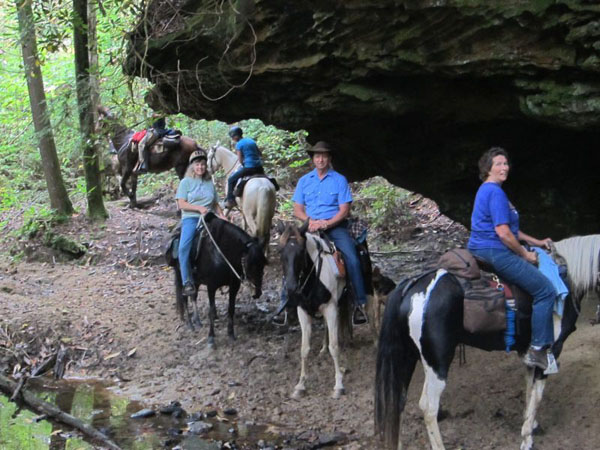
Wild weather didn’t stop Susan St. Amand from having fun at Big South Fork Recreation Area as part of Equitrekking’s 50 State Trail Riding Project.
by Susan St. Amand
About Big South Fork Recreation Area
Big South Fork Recreation Area is located on the Northeastern end of Tennessee, straddling the Tennessee and Kentucky state lines, turning into the Daniel Boone National Forest on the Kentucky end. It is located between Oneida, Tennessee via Route 297 and Jamestown, Tennessee via Route 154. The Big South Fork Recreation Area is comprised of 120,000 acres and over 212 miles of horseback riding trails.
Our group entered from the east side of Big South Fork from Oneida. This route entails going through “the Gorge” which involves hairpin turns going up and/or down to enter the Big South Fork Recreation area. Caution--slow speeds and good working truck and trailer brakes are essential to maneuver this area...
Read more here:
http://www.equitrekking.com/articles/entry/trail-riding-at-big-south-fork-recreation-area-in-tennessee/?mc_cid=07911f088b&mc_eid=290b655fe3
Subscribe to:
Posts (Atom)