SMDailyjournal.com - Full Article
January 09, 2017, 05:00 AM By Austin Walsh Daily
Proprietors of an expansive equestrian ranch in Pacifica are availing more than 100 acres of open space to nonprofit organizations interested in offering unique community enrichment programs.
Sweeney Ridge Equestrian, at 650 Cape Breton Drive, is a horse boarding facility adjacent to the Golden Gate National Recreation Area with access to a sweeping network of trails for riding horses, hiking or a variety of other outdoor activities.
An equestrian company previously occupying the stables has relocated, opening the opportunity for the ranch to broaden its horizons, said property manager Brenda Davis.
“We have the space, we have access to the trails as well as covered arenas … and we are hoping to draw in a couple of nonprofits to expand that part of the facility,” said Davis. “We want something that can give back in that manner...”
- See more at: http://www.smdailyjournal.com/articles/lnews/2017-01-09/100-acre-horse-ranch-in-pacifica-seeking-new-nonprofit-partners/1776425173980.html#sthash.93OdgjJ7.dpuf
Monday, January 9, 2017

Saturday, January 7, 2017
U.S. House changes its rules to ease federal land transfers
HCN.org - Full Article
The Western movement to transfer federal lands scores an early victory in the new Congress.
Elizabeth Shogren
DC DISPATCH Jan. 4, 2017
Web Exclusive
On the first day of its new session, the U.S. House passed a new rule designed to make it easier to transfer federal lands to states, local communities or Indian tribes by assuming that these transfers would not cost the federal government anything.
The change was approved Tuesday 233 to 190 as part of a broader collection of rules which will govern how the House will operate during the 115th Congress ranging from budget guidelines to ethics standards. The lands transfer provision didn’t figure in the debate. Previously, when Congress wanted to transfer public lands managed by the Forest Service, Bureau of Land Management or other federal agency, the Congressional Budget Office, Congress’ research arm, calculated the cost to the U.S. Treasury by computing what revenues the lands provide over 10 years, such as grazing fees or oil and gas royalties. Under House rules, before a bill approving a transfer could be adopted, budget cuts would have to be made in other federal programs equal to the value of that land. The rules change eliminates that budgetary barrier to land transfer bills...
Read more here:
http://www.hcn.org/articles/u-s-house-changes-its-rules-to-ease-federal-land-transfers?utm_source=wcn1&utm_medium=email
The Western movement to transfer federal lands scores an early victory in the new Congress.
Elizabeth Shogren
DC DISPATCH Jan. 4, 2017
Web Exclusive
On the first day of its new session, the U.S. House passed a new rule designed to make it easier to transfer federal lands to states, local communities or Indian tribes by assuming that these transfers would not cost the federal government anything.
The change was approved Tuesday 233 to 190 as part of a broader collection of rules which will govern how the House will operate during the 115th Congress ranging from budget guidelines to ethics standards. The lands transfer provision didn’t figure in the debate. Previously, when Congress wanted to transfer public lands managed by the Forest Service, Bureau of Land Management or other federal agency, the Congressional Budget Office, Congress’ research arm, calculated the cost to the U.S. Treasury by computing what revenues the lands provide over 10 years, such as grazing fees or oil and gas royalties. Under House rules, before a bill approving a transfer could be adopted, budget cuts would have to be made in other federal programs equal to the value of that land. The rules change eliminates that budgetary barrier to land transfer bills...
Read more here:
http://www.hcn.org/articles/u-s-house-changes-its-rules-to-ease-federal-land-transfers?utm_source=wcn1&utm_medium=email
Friday, January 6, 2017
Push To Transfer Federal Lands To States Has Sportsmen On Edge
NPR.org - read of listen
January 5, 20175:00 AM ET
Heard on Morning Edition
Wyoming has become a flash point in the debate over whether hundreds of millions of acres of federal public lands should be turned over to state hands.
From Buzz Hettick's place on the edge of the windswept college town of Laramie, it's a short drive into the heart of these remote lands, vast tracts run by the federal Bureau of Land Management.
On a recent, blustery morning, Hettick was scouting out an elk hunt in the Laramie range, a patchwork of private and public BLM land north of his home.
"A lot of wildlife uses public lands," he says.
So do big game hunters like Hettick. Hunting is big business in the rural West and Wyoming is no exception. A recent study estimated it brings in roughly $25 million into Albany County's economy alone.
Hettick is eager to show off this land — and talk about protecting access to it — to anyone who will make the trip.
"I just don't see how people can look at this out here ... and all they see is a dollar sign attached to it; there's a lot more than that," Hettick says.
When it comes to politics, those dollar signs and federal lands are inextricably linked in the West. There's always pressure to lease more land to private producers of oil, gas, coal and, lately, wind...
Read more here:
http://www.npr.org/2017/01/05/508018599/push-to-transfer-federal-lands-to-states-has-sportsmen-on-edge?sc=tw
January 5, 20175:00 AM ET
Heard on Morning Edition
Wyoming has become a flash point in the debate over whether hundreds of millions of acres of federal public lands should be turned over to state hands.
From Buzz Hettick's place on the edge of the windswept college town of Laramie, it's a short drive into the heart of these remote lands, vast tracts run by the federal Bureau of Land Management.
On a recent, blustery morning, Hettick was scouting out an elk hunt in the Laramie range, a patchwork of private and public BLM land north of his home.
"A lot of wildlife uses public lands," he says.
So do big game hunters like Hettick. Hunting is big business in the rural West and Wyoming is no exception. A recent study estimated it brings in roughly $25 million into Albany County's economy alone.
Hettick is eager to show off this land — and talk about protecting access to it — to anyone who will make the trip.
"I just don't see how people can look at this out here ... and all they see is a dollar sign attached to it; there's a lot more than that," Hettick says.
When it comes to politics, those dollar signs and federal lands are inextricably linked in the West. There's always pressure to lease more land to private producers of oil, gas, coal and, lately, wind...
Read more here:
http://www.npr.org/2017/01/05/508018599/push-to-transfer-federal-lands-to-states-has-sportsmen-on-edge?sc=tw
Thursday, January 5, 2017
Wyoming: Proposals could restrict riding access in Shoshone NF
Codyenterprise.com - Full Article
January 5 2017
By LEW FREEDMAN
Proposals that would restrict or close selected riding access for mountain bikers in the Shoshone National Forest have stirred angst amongst regional riders.
They are banding together to question the plans before the public comment period ends Jan. 12.
Riders claim the Forest is poised to take unnecessary action under its Land Management Plan, while Forest officials say they are merely balancing the needs of all trail users, including mountain bikers, horseback riders and ATV travelers.
One part of the plan would add 35 miles of approved biking trails, while another would subtract what some say is 28 miles of existing trails.
Mountain bikers say they could well lose access to places they are long used to riding.
John Gallagher of the Park County Pedalers said the Shoshone non-motorized trail plan is really responding to issues that have occurred elsewhere, in Utah and Colorado, where participants in the different activities have overlapped...
Read more here:
http://www.codyenterprise.com/news/local/article_e5d8c260-d2c2-11e6-a62d-e3a25fdc0433.html
January 5 2017
By LEW FREEDMAN
Proposals that would restrict or close selected riding access for mountain bikers in the Shoshone National Forest have stirred angst amongst regional riders.
They are banding together to question the plans before the public comment period ends Jan. 12.
Riders claim the Forest is poised to take unnecessary action under its Land Management Plan, while Forest officials say they are merely balancing the needs of all trail users, including mountain bikers, horseback riders and ATV travelers.
One part of the plan would add 35 miles of approved biking trails, while another would subtract what some say is 28 miles of existing trails.
Mountain bikers say they could well lose access to places they are long used to riding.
John Gallagher of the Park County Pedalers said the Shoshone non-motorized trail plan is really responding to issues that have occurred elsewhere, in Utah and Colorado, where participants in the different activities have overlapped...
Read more here:
http://www.codyenterprise.com/news/local/article_e5d8c260-d2c2-11e6-a62d-e3a25fdc0433.html
California: When trails end: Nipomo landowners and equestrians battle over horseback riding routes on the Mesa
Santamariasun.com - Full Article
BY JENNIFER BEST
January 4 2017
Like countless hikers and horsemen, dog walkers and joggers, Doreen Lopez has been riding and hiking the trails through Nipomo’s eucalyptus groves and along its sandy bluffs for decades. Like untold numbers of property owners, Jim Harrington hoped to enjoy the peace and quiet of country living in the privacy of his own home. Today, the pair embodies the battle over public access to private property that increasingly repeats itself as communities develop.
As rural areas build out and open spaces are fenced, walled, and paved, property owners assert their rights to use their space, while longtime residents mourn the loss of land they have walked, hiked, biked, and ridden for years, even decades.
“These people come from the city and want a place in the country, then they fence it off and complain about the smells and sounds of country life,” Lopez said.
In October, Harrington fenced portions of his property after run-ins with equestrian users.
“I’m a nice guy, but I can only be stepped on, walked around, kicked so much,” Harrington said. “I love horses. I ride horses. The whole thing got out of control when one lady wouldn’t listen to me. All I want to do is be legal about it. If they’re going to be snooty and sniping and act like this is their land, I’m old enough to know better. I spent my life working my ass off. Now I want to hide out, be left alone, have peace and quiet.”
In November, representatives of Ride Nipomo Equestrian Trails Alliance met with county staff to discuss options for re-opening the trail, potential easements, and other actions that might return the trail to public service.
“It’s not just for equestrians,” Ride Nipomo President Shelia Patterson said. “We can deal with hikers and bikers, just like we do when we ride Montaña de Oro [State Park]. We can all work together, but we have to have this one vision that we need trails for everyone. It’s about people and health and the kindness people show each other on trails. I’ve never met a mean person on the trail.”
Since 2001, Ride Nipomo Equestrian Trails Alliance has promoted the establishment, conservation, and maintenance of equestrian trails in southern San Luis Obispo County. They adopt trails and perform cleanups along the trails in parks and on private properties where public access is granted.
“We’re not out there to spy on the neighborhood or to trespass. We’re their eyes and ears. We find dump spots and report what we find, we clean it up, and we’ve paid to take thousands of pounds of trash away,” the alliance’s unofficial historian, Barbara Verlengiere, told the Sun.
Alliance members would like to see the preservation of established trails like those along Nipomo’s southwestern bluff, and long-term planning like that used in Norco. That Southern California community, also known as Horsetown, U.S.A, maintains narrow streets, slow speed limits, and 74 miles of trails to promote travel on horseback and horse-drawn carriage.
“That’s what we’re looking for,” said Verlengiere, who left Southern California 35 years ago to settle in then-very-rural Nipomo. “The problem is all these people who come from LA who want it to be like where they came from. They complained about Nipomo Park, the charro arena, horses, cattle, smells. This is the problem. We lost our arena. We’re losing our trails. You live in the country now. Get used to it.”..
Read more here:
http://www.santamariasun.com/cover/15550/when-trails-end-nipomo-landowners-and-equestrians-battle-over-horseback-riding-routes-on-the-mesa/
BY JENNIFER BEST
January 4 2017
Like countless hikers and horsemen, dog walkers and joggers, Doreen Lopez has been riding and hiking the trails through Nipomo’s eucalyptus groves and along its sandy bluffs for decades. Like untold numbers of property owners, Jim Harrington hoped to enjoy the peace and quiet of country living in the privacy of his own home. Today, the pair embodies the battle over public access to private property that increasingly repeats itself as communities develop.
As rural areas build out and open spaces are fenced, walled, and paved, property owners assert their rights to use their space, while longtime residents mourn the loss of land they have walked, hiked, biked, and ridden for years, even decades.
“These people come from the city and want a place in the country, then they fence it off and complain about the smells and sounds of country life,” Lopez said.
In October, Harrington fenced portions of his property after run-ins with equestrian users.
“I’m a nice guy, but I can only be stepped on, walked around, kicked so much,” Harrington said. “I love horses. I ride horses. The whole thing got out of control when one lady wouldn’t listen to me. All I want to do is be legal about it. If they’re going to be snooty and sniping and act like this is their land, I’m old enough to know better. I spent my life working my ass off. Now I want to hide out, be left alone, have peace and quiet.”
In November, representatives of Ride Nipomo Equestrian Trails Alliance met with county staff to discuss options for re-opening the trail, potential easements, and other actions that might return the trail to public service.
“It’s not just for equestrians,” Ride Nipomo President Shelia Patterson said. “We can deal with hikers and bikers, just like we do when we ride Montaña de Oro [State Park]. We can all work together, but we have to have this one vision that we need trails for everyone. It’s about people and health and the kindness people show each other on trails. I’ve never met a mean person on the trail.”
Since 2001, Ride Nipomo Equestrian Trails Alliance has promoted the establishment, conservation, and maintenance of equestrian trails in southern San Luis Obispo County. They adopt trails and perform cleanups along the trails in parks and on private properties where public access is granted.
“We’re not out there to spy on the neighborhood or to trespass. We’re their eyes and ears. We find dump spots and report what we find, we clean it up, and we’ve paid to take thousands of pounds of trash away,” the alliance’s unofficial historian, Barbara Verlengiere, told the Sun.
Alliance members would like to see the preservation of established trails like those along Nipomo’s southwestern bluff, and long-term planning like that used in Norco. That Southern California community, also known as Horsetown, U.S.A, maintains narrow streets, slow speed limits, and 74 miles of trails to promote travel on horseback and horse-drawn carriage.
“That’s what we’re looking for,” said Verlengiere, who left Southern California 35 years ago to settle in then-very-rural Nipomo. “The problem is all these people who come from LA who want it to be like where they came from. They complained about Nipomo Park, the charro arena, horses, cattle, smells. This is the problem. We lost our arena. We’re losing our trails. You live in the country now. Get used to it.”..
Read more here:
http://www.santamariasun.com/cover/15550/when-trails-end-nipomo-landowners-and-equestrians-battle-over-horseback-riding-routes-on-the-mesa/
Wednesday, January 4, 2017
Register for Hike the Hill 2017
January 4 2017
Hike the Hill 2017 will be held February 12-15 at the Washington Plaza Hotel in Washington, D.C.
Now in its 19th year, Hike the Hill® is a joint effort between the Partnership for the National Trail System and the American Hiking Society aimed at increasing congressional and federal agency leader awareness of funding and other needs that sustain the National Trails System. Each February, trail partners and organizations from across the nation head to Washington, D.C. to discuss current initiatives, legislation, and goals for the future with federal partners, congressmen or their staff, and fellow trail organizations.
Learn more and register at https://americanhiking.org/hike-the-hill/hth2017/
Hike the Hill 2017 will be held February 12-15 at the Washington Plaza Hotel in Washington, D.C.
Now in its 19th year, Hike the Hill® is a joint effort between the Partnership for the National Trail System and the American Hiking Society aimed at increasing congressional and federal agency leader awareness of funding and other needs that sustain the National Trails System. Each February, trail partners and organizations from across the nation head to Washington, D.C. to discuss current initiatives, legislation, and goals for the future with federal partners, congressmen or their staff, and fellow trail organizations.
Learn more and register at https://americanhiking.org/hike-the-hill/hth2017/
Sunday, January 1, 2017
What You Can Do to Keep Horse Trails Open
 Trailmeister.com - Full Article
December 27 2016
by Robert Eversole
Keeping Paradise Possible
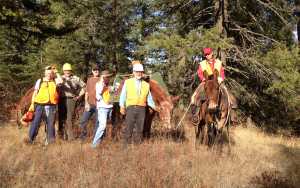
Paradise. For some that’s an image of a tropical beach, for me it’s a dirt trail that twists and meanders to a backcountry camp deep in the wilderness. It’s a quiet solitude punctuated by the peaceful clip clop of hooves and the far scream of an eagle aloft. It’s the sweet perfume of pine on a warm summer day. It’s the companionship of a trusted horse who will faithfully take you home.
Unfortunately, in a growing number of cases paradise is padlocked.
In only a few short generations we’ve “improved” a lot of backcountry and rural areas into suburbia and shopping malls. Trail Closed signs are both dreaded and unfortunately frequently encountered. Lest we lose them, we’d better take care of the equine friendly country that remains. Paradise needs protecting.
You don’t have to be a trail rider, or even have your own horse, to recognize the importance of conserving horse trails. There are many things that each of us can do to preserve equine trails. The following are three easy ways that I have found to help.
Volunteer
It’s not forest elves that are magically keeping your trails open. Budget cuts have slashed maintenance efforts on public lands. Most trail maintenance is done by volunteer organizations such as your state’s Horse Council, or your local Back Country Horsemen chapter...
Read more here:
https://www.trailmeister.com/what-you-can-do-to-keep-horse-trails-open/
Subscribe to:
Posts (Atom)